
What Is a Conex Box? Sizes, Names, and What to Check Before You Get One
A conex box is a steel shipping container. Here is where the name came from, what sizes exist, how it differs from a sea van or storage container, and what to confirm with your county before one arrives.
A Conex box is a steel shipping container, a name that started with the U.S. Army’s “Container, Express” boxes of the 1950s and now covers almost any 20-foot or 40-foot steel container. API Trailers supplies 8×20 and 8×40 sea vans and 8×24 storage containers for lease or purchase and can deliver anywhere in California, though longer hauls add delivery cost. Permits and local rules may apply depending on your county and city, so confirm yours before you order. Call 805-328-6031.
Search for a Conex box and you get a mix of military history, dealer listings, and price charts. Very little of it tells you what you are allowed to put on your property or which size fits your gear. This guide covers the name, the sizes, the wind and ground questions people ask most, and the permit question that decides whether a container can stay.
API has supplied sea vans and storage containers to California contractors, businesses, and individuals since 1983, and delivers with its own trucks. For lease terms and condition grades, see the storage container rental guide. For the full lineup, see API’s sea van containers page.

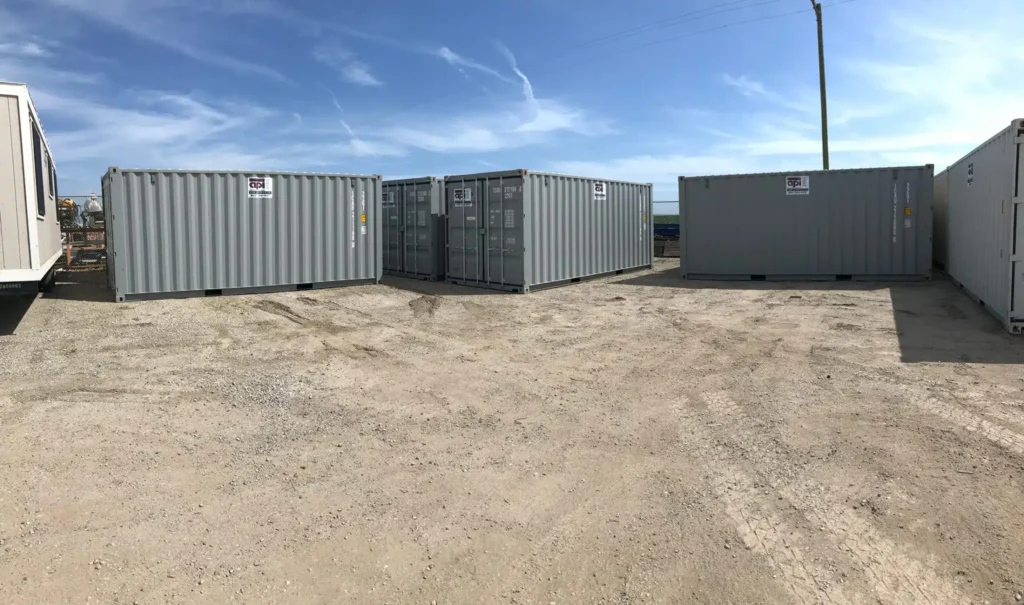
Steel shipping containers with API decals staged on a gravel lot
What Is a Conex Box?
A Conex box is a steel shipping container. The name comes from CONEX, short for “Container, Express,” the modular steel boxes the U.S. Army Transportation Corps introduced in late 1952, building on a 1948 design called the Transporter that proved itself in the Korean War.
Those original boxes were small by today’s standards: 8 ft 6 in long, 6 ft 3 in wide, and 6 ft 10 in high, with a 9,000-pound capacity, according to the CONEX history. Shipping later standardized on larger ISO containers, and Conex stayed on as the everyday word for them. The U.S. military still uses CONEX for the larger ISO boxes.
Conex Box vs. Shipping Container vs. Sea Van vs. Storage Container: What Is the Difference?
Mostly nothing. These names describe the same kind of steel box, and which one you hear depends on who is talking. Searchers also type seavan, seavans, and container van for the same thing.
| Name | What It Usually Means |
|---|---|
| Conex box | Everyday word for a steel shipping or storage container. Originally the Army’s small “Container, Express” box. |
| Shipping container | A standardized steel box built to move freight by ship, rail, and truck, usually 20 or 40 feet long. |
| ISO container | The technical name for a shipping container built to international standards. |
| Sea van (also seavan) | API Trailers’ term for its 8×20 and 8×40 shipping containers. |
| Storage container | Any container used for stationary storage. API’s 8×24 storage container has full-opening double doors on each end and 1,500 cubic feet of capacity. |
| MILVAN | The U.S. military term for a shipping container. |
If you are shopping, ask for the size, the condition grade, and the door layout instead of the name. The name changes from seller to seller, and those three details do not.

An API storage container with double doors, set on a residential driveway
What Sizes Do Conex Boxes Come In?
Most Conex boxes are 20 or 40 feet long, 8 feet wide, and 8 feet 6 inches tall on the outside. API Trailers supplies 8×20 and 8×40 sea vans, built from 14-gauge corrugated steel with 1 1/8 inch marine plywood floors and cargo doors on one end, plus an 8×24 storage container.
| Size | Exterior | Interior | Empty Weight | Capacity |
|---|---|---|---|---|
| 20 ft sea van (8×20) | 20′ x 8′ x 8’6″ | 19’4″ x 7’8″ x 7’10” | About 4,820 lb (data plate on an API unit) | 1,173 cu ft (data plate) |
| 40 ft sea van (8×40) | 40′ x 8′ x 8’6″ | 39’5″ x 7’8″ x 7’10” | About 8,380 lb (typical ISO figure) | About 2,370 cu ft (calculated from interior size) |
| Storage container (8×24) | 24′ x 8′ | Call for specs | Call for specs | 1,500 cu ft |
Weights and capacities vary slightly by unit, and the data plate on the container door lists the exact figures. Typical ISO weights come from the intermodal container specifications.
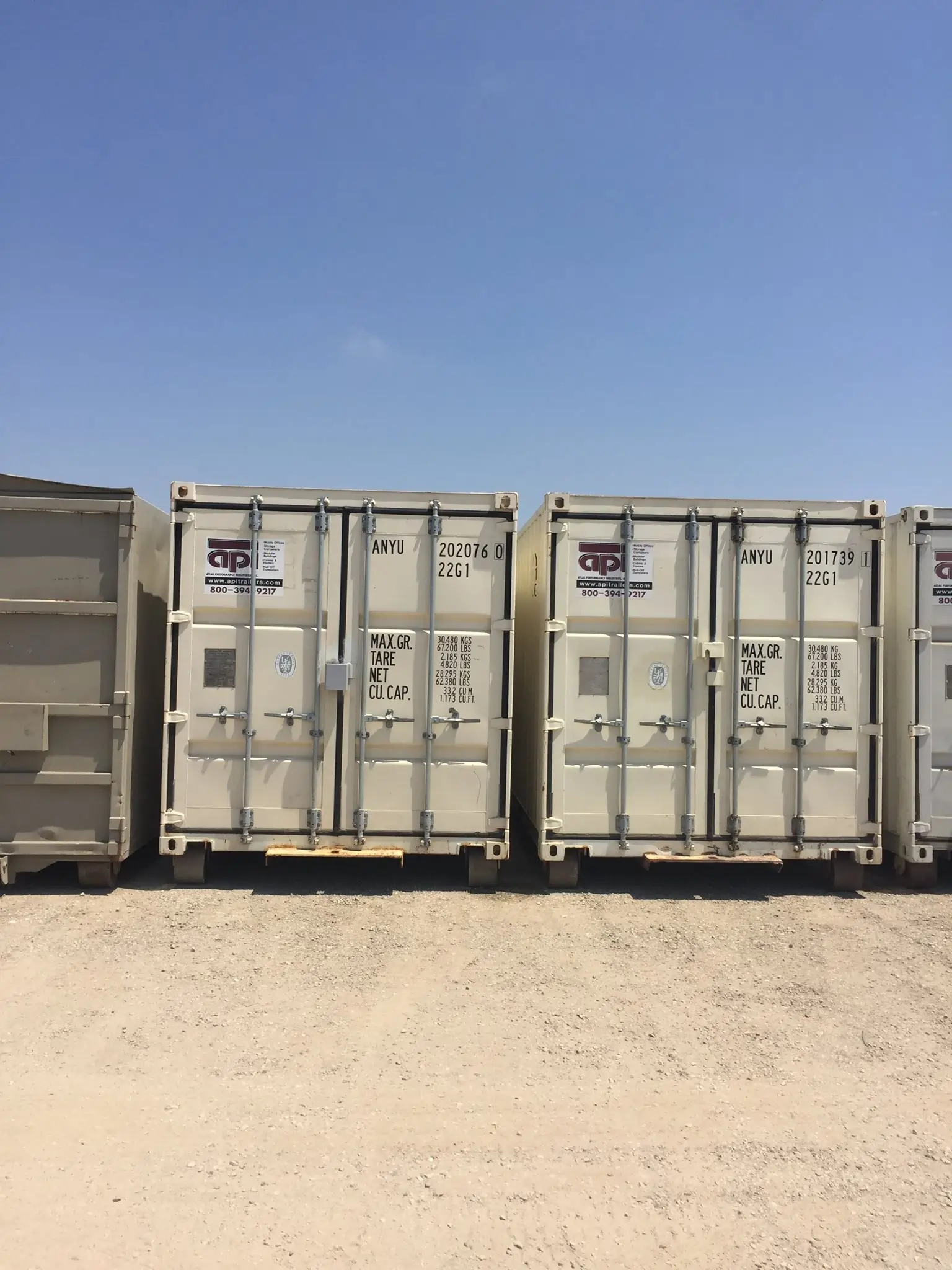
The data plate on an API 20-foot container: 67,200 lb max gross, 4,820 lb empty, 1,173 cubic feet
How Wide Is the Inside of a Conex Box?
About 7 feet 8 inches on API’s 20-foot and 40-foot sea vans, with 7 feet 10 inches of interior height. API’s smallest unit is the 8×20 sea van, at 19 feet 4 inches of interior length.
Which Condition Should You Get?
| Grade | What It Means |
|---|---|
| New / One Trip | Best condition, shipped only one time |
| Cargo-Worthy | Structural integrity still good enough for shipping lines |
| Used | Wind and water tight, suitable for most storage uses |
| As Is | Minor damage, still considered weather resistant |
| Modified | New or used, modified to suit the customer’s needs |
Not sure which size or grade fits?
Call API Trailers with what you plan to store and where it will sit. We will match a size and confirm availability.
Can Wind Move a Conex Box?
Yes. An empty 20-foot container weighs roughly 4,800 pounds, and strong wind can push, slide, lift, or tip one that is not secured.
The usual fixes are ground anchors, helical (screw) anchors, or bolting the container to a concrete base, depending on the soil and how long the container will stay. If you lease from API Trailers, ask first: API’s container lease agreement says units shall not be attached or affixed to real property, so any anchoring needs API’s approval. Whatever supplier you use, ask your county or city whether it has anchoring requirements of its own, and consider having a contractor or structural engineer specify the anchoring for your soil and wind exposure.
Do You Need a Concrete Slab for a Conex Box?
Not always. For short-term placement, a container commonly sits on a compacted gravel pad, cement blocks, or railroad ties. For long-term placement, the container should sit on a proper foundation that keeps it level and away from groundwater. Concrete is one of the options.
For an API Trailers delivery, the lease agreement requires a flat, level surface for placement, and the customer confirms the placement area can support the weight of the container and the delivery truck.

A container resting on level gravel ground
If you are unsure, ask a contractor or structural engineer which foundation fits your soil, your container, and how long it will stay. Your county or city may also have its own rules for how a container must be set.
Do You Need a Permit for a Conex Box in California?
It depends on your county and city, and the rules change over time. Placement rules are set locally, so your planning and building department decides whether a container is allowed on your parcel, where it can sit, and what permit it needs.
One Example: Unincorporated San Luis Obispo County
San Luis Obispo County Code section 19.02.080, adopted in 2016, allows cargo containers for storage or other structural purposes, but not for human habitation, with conditions. This summary reflects the code as reviewed in September 2026 and may have changed since.
- The container must be modified under a county permit to meet California Building Code requirements for its proposed use.
- Location is limited to agricultural or rural lands on parcels of 20 acres or more, or to places where the planning director finds the container will not be visible from public roads or adjoining properties.
- In commercial and industrial zones, containers must be screened from public roads. Multiple containers there must be painted the same color and cannot be stacked.
Those rules apply to unincorporated county land. Every other California county and city sets its own rules, including Santa Barbara County, and they can differ from this example.
Questions to Ask Your County or City
- Is a storage container allowed on my parcel and in my zone?
- Are there limits on the size, number, or stacking of containers?
- Do I need screening, a set paint color, or a setback from property lines?
- Do I need a permit, and is a temporary permit available?
- If I modify the container with doors, windows, or an office conversion, what permit and building code apply?
- How long may the container stay?
Buy or Lease a Conex Box From API Trailers
API leases and sells sea vans and storage containers and delivers with its own trucks. API Trailers can deliver anywhere in California, and the customer pays the delivery charge. That charge rises with distance from API’s Santa Maria yard, so a far-away site may not be cost-effective, especially for a short lease. Call 805-328-6031 with your address for a delivery quote.
If you are searching for shipping containers in Santa Maria, Santa Barbara, or San Luis Obispo County, you are close to API’s yard, which typically makes delivery the most cost-effective.

API’s own truck and flatbed trailer hauling a container
Modifications such as doors, windows, and interior shelving can be added. For current options in your area, see storage containers in Santa Maria or browse containers for sale.
Delivered by the Same Team Since 1983
API Trailers (Atlas Performance Industries, Inc.) has supplied storage containers and sea vans to California contractors, businesses, and individuals since 1983. Delivery runs on API’s own fleet of trucks, so the same company that quotes your container also puts it on your site.
California
8×20, 8×40, and 8×24
new to modified
Frequently Asked Questions
Ready to get a sea van or storage container delivered?
API Trailers builds its delivery around your site. Confirm your county or city rules first, then call to match a size and get a delivery quote for your address.