
What Is a
Modular Building?
A straight answer to one of the most common questions in California construction to what modular buildings are, how they are built, what they can be used for, and why factory-direct manufacturing changes everything.
California modular building manufacturer since 1983 · Factory-direct · Serving all of California
A modular building is a structure built in sections inside a controlled factory environment, then transported to a site and assembled on a foundation. Modular buildings are constructed to the same building codes as conventional structures to and in California, to California Department of Housing and Community Development (DOH) standards to but are completed faster, with greater quality control, and at lower overall cost than traditional on-site construction. They can be temporary or permanent, and they can serve virtually any use: offices, classrooms, clinics, fire stations, government facilities, wineries, churches, and more.
If you have ever driven past a construction site and noticed a professional-looking building that appeared seemingly overnight, or walked into a school classroom that felt solid and well-finished despite being described as “portable,” you have likely already been inside a modular building. They look like permanent structures. They function like permanent structures. The difference is where and how they are built to and that difference is what makes them faster, more cost-effective, and more flexible than conventional construction for a wide range of California projects.
How a Modular Building Is Built
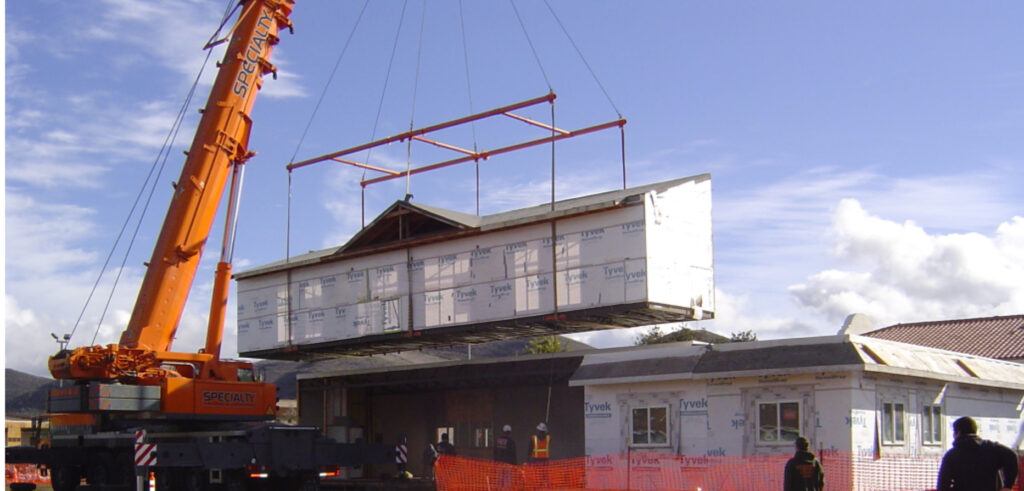
The defining characteristic of a modular building is that it is built in a factory to not on the job site. The building is constructed in sections, called modules, inside a controlled manufacturing environment. Each module is framed, insulated, wired, plumbed, and finished before it ever leaves the factory. Windows are installed. Flooring goes down. HVAC systems are fitted. Interior walls are painted. By the time a module is loaded onto a truck, it is substantially complete.
Those modules are then transported to the project site and assembled on a prepared foundation. Where the modules connect, the seams are sealed, finished, and inspected. Utility connections are made. Within days of delivery, the building is ready for occupancy.
This is fundamentally different from conventional construction, where every stick of framing, every piece of drywall, every electrical run, and every finish coat is applied on-site to exposed to weather, dependent on subcontractor scheduling, and subject to the full complexity of California’s permitting and inspection process at every stage.
API Trailers: A True California Manufacturer
Most companies selling or leasing modular buildings in California are dealers to they source units from third-party manufacturers, mark them up, and pass them along. API Trailers is not a dealer.
API Trailers (Atlas Performance Industries, Inc.) designs and builds every modular building in its own factory in Santa Maria, California. Our engineers create the floor plans. Our craftsmen build the modules. Our delivery team transports and assembles them. When you work with API Trailers, you are working directly with the manufacturer to no intermediaries, no markups passed through a distribution chain, and full accountability from the people who actually built your building.
That is a distinction that matters to in quality, in cost, in customization capability, and in accountability when something needs to be resolved.
The Advantages of Modular Construction in California
Faster Project Delivery
One of the most significant advantages of modular construction is schedule compression. Because the building is constructed in the factory while site preparation to grading, foundation work, utility rough-ins to is happening simultaneously on your property, the overall project timeline is dramatically shorter than conventional construction. You do not wait for site work to finish before building begins. Both happen at the same time.
In California, where conventional construction timelines are stretched by labor availability, permit queues, and weather, the modular schedule advantage is especially pronounced. Projects that would take 12 to 18 months to construct conventionally can often be delivered in modular in 4 to 8 months.
Consistent Quality Control
Factory construction offers a quality control advantage that on-site construction cannot match. Work happens in a weather-protected, climate-controlled environment with consistent material handling, fixed inspection stations, and a workforce that builds the same components every day. There is no rain delay that warps framing. No subcontractor who shows up short-staffed. No inspection that gets rescheduled three times.
At API Trailers, California DOH inspectors certify every modular building before it leaves the factory. The building arrives at your site already inspected and approved to not waiting for a field inspection that may or may not happen on schedule.
Cost Efficiency
Modular construction typically costs less than equivalent conventional construction for several reasons: factory efficiency reduces labor costs, bulk material purchasing reduces material costs, and the compressed timeline reduces financing carrying costs and project overhead. For California projects to where construction costs are among the highest in the nation to these savings are meaningful.
When you add factory-direct manufacturing to the equation, as with API Trailers, the cost advantage increases further. There is no dealer margin. No distribution markup. The price you pay reflects what it actually costs to design and build the structure, plus API’s margin to nothing more.
Flexibility to Temporary or Permanent
Modular buildings can be designed and permitted as either temporary or permanent structures. A temporary modular building can be disassembled and relocated at the end of a project to making it the right choice for construction site headquarters, school district expansion during renovation, healthcare overflow facilities, and real estate sales offices. A permanent modular building is installed on a foundation and permitted exactly like a conventional structure to indistinguishable from site-built construction once complete.
At API Trailers, we build both to the same standard. The decision between temporary and permanent is a permitting and planning decision, not a construction quality decision.
California DOH Certification and ADA Compliance
In California, factory-built structures including modular buildings must meet California Department of Housing and Community Development (DOH) building code standards. DOH certification confirms that the structure meets California’s requirements for structural integrity, electrical systems, plumbing, fire safety, and energy efficiency. All API Trailers modular buildings are California DOH certified to inspected and approved before they leave the factory.
All API Trailers modular buildings are also built to current ADA accessibility standards, including compliant entry, door widths, restroom configurations, and interior clearances. For government agencies, school districts, healthcare organizations, and any publicly accessible facility, ADA compliance is mandatory to and it is standard on every API build.
What Can a Modular Building Be Used For?
Modular construction is not limited to a single building type or industry. Any structure that can be built conventionally can be built modularly to often faster and at lower cost. In California, API Trailers has designed and built modular structures for virtually every use imaginable.
Office Space
Single and multi-room office complexes for contractors, developers, government agencies, and corporations to temporary or permanent.
Classrooms & Education
Portable classrooms, administrative buildings, and full school facilities for California school districts and universities.
Healthcare & Clinical
Medical clinics, crisis stabilization units, labs, and administrative facilities to ADA compliant and California DOH certified.
Government & Municipal
Fire stations, libraries, court facilities, water district offices, parks buildings, and public administration facilities.
Hospitality & Retail
Winery tasting rooms, event spaces, retail buildings, car rental facilities, and concession stands.
Housing & Residential
Employee housing, barracks, bunkhouses, personal cabins, granny flats, and residential additions.
Religious & Nonprofit
Churches, community centers, social service facilities, and nonprofit administrative buildings to financing available.
Industrial & Energy
Remote field offices, training facilities, guard stations, and operational headquarters for energy, utilities, and industrial operations.
API Trailers to Completed California Modular Building Projects
- UC Merced to University of California
- Santa Rosa Fire Station
- West Basin Municipal Water District, El Segundo
- YMCA, Santa Maria
- New Cuyama Library
- Payless Car Rental, South San Francisco
- Regional Wastewater Training Facility, Santa Clara
- Woods Humane Society, Atascadero
- Crisis Stabilization Unit, San Luis Obispo
- California State Parks, Carpinteria
- Epoch Winery, Templeton
- Santa Barbara County Fire Station, Sisquoc
- USFS Rock Creek Barracks, Mammoth Lakes
- UCSB AS Bike Shop, Santa Barbara
- Lompoc Foursquare Church
- Cal Poly AG Department Housing, San Luis Obispo
- Paso Robles Horse Park
- Port of Long Beach
Modular Buildings vs. Conventional Construction: A Direct Comparison
| Factor | Modular Construction | Conventional Construction |
|---|---|---|
| Where it’s built | Factory to controlled environment | On-site to exposed to weather and conditions |
| Timeline | 30–50% faster to site work runs parallel to factory build | Sequential to site must be ready before building begins |
| Quality control | Factory inspection at every stage, DOH certified before delivery | Field inspection to varies by inspector and schedule |
| Cost | Typically lower to factory efficiency, bulk materials, compressed timeline | Higher to on-site labor, weather delays, extended financing costs |
| Flexibility | Temporary or permanent to can be relocated if needed | Permanent only to cannot be moved |
| Customization | Fully customizable in factory before delivery | Fully customizable on-site |
| California DOH | Factory-certified to arrives pre-approved | Field inspected at each stage |
| ADA compliance | Built to ADA standards in factory | Designed and built to ADA on-site |
Have a project in mind?
API Trailers designs and builds modular buildings in our own California factory to no third parties, no middlemen. Call us and let’s talk through what your project needs.
Frequently Asked Questions
Ready to build?
API Trailers designs and manufactures modular buildings in our own California factory to serving contractors, developers, government agencies, schools, and businesses across the state since 1983. No third parties. No middlemen. Just a straight answer about what we can build for you.